Gauntlet Gallery
What is KAWS’s piece called “Woodstock (Kaws Version)”?
Summary
Woodstock (Kaws Version) reinterprets the beloved Peanuts character Woodstock, Snoopy's small yellow bird companion, through KAWS's distinctive lens. KAWS has long engaged the Peanuts universe, recasting Charles Schulz's gentle characters with his trademark X eyes and smoothed, sculptural cartoon forms. The result keeps the affectionate familiarity of the original while introducing the uncanny, slightly mournful quality that defines KAWS's appropriations. Rendered as a bold, flat graphic in saturated color, the piece reads instantly as both Woodstock and unmistakably KAWS, a hallmark of his strategy of layering his own iconography over cherished pop-culture characters.
Why It Matters
KAWS's engagement with Peanuts is one of the most celebrated threads in his career, encompassing major collaborations, large-scale sculptures, plush toys, and exhibitions. Woodstock (Kaws Version) participates in that lineage, applying his appropriation method to one of the most universally beloved comic-strip casts in history. The significance lies in the tension KAWS creates: he takes characters tied to childhood innocence and nostalgia and overlays them with his signature crossed-out eyes, a motif associated with absence, mortality, and a knowing melancholy. This recontextualization is precisely what made KAWS a critical and commercial phenomenon, demonstrating how appropriation can renew familiar imagery and provoke fresh emotional resonance. For collectors, Peanuts-derived KAWS works carry both the cachet of his brand and the warmth of Schulz's universe, a combination that has proven exceptionally durable across editions, sculptures, and collaborative products.
Collector Perspective
This piece attracts collectors drawn to KAWS's Peanuts collaborations specifically, as well as broader fans of pop-culture crossovers. It pairs naturally with Snoopy-themed KAWS works to build a thematic grouping, and its recognizable, friendly subject makes it approachable for display in homes, studios, and design-forward spaces. Buyers value the dual appeal of nostalgia and contemporary edge. Within a KAWS collection it serves as a charismatic, character-driven anchor. As always, collectors should verify the exact medium, edition, and authenticity before purchase, since Peanuts-related KAWS imagery spans many formats.
Historical Context
KAWS's relationship with Peanuts deepened over the 2010s through high-profile collaborations, plush editions, and monumental sculptures, situating the franchise as a recurring touchstone in his mature practice. Woodstock (Kaws Version) fits this period, when KAWS moved fluidly between fine art, product, and public installation while repeatedly returning to appropriated cartoon icons. The work reflects his established method of overlaying personal iconography onto pre-loved characters, a technique honed since his subway-era ad interventions and carried forward into a globally recognized brand.
FAQ
Who is Woodstock in this work?
Woodstock is Snoopy's small yellow bird friend from Peanuts, here reinterpreted through KAWS's signature style with his characteristic X eyes.
Did KAWS officially work with Peanuts?
KAWS has produced celebrated Peanuts-related works and collaborations across editions, plush, and sculpture; buyers should confirm the specific licensing and edition with the seller.
What makes the KAWS version distinct?
He overlays his own iconography, especially the crossed-out eyes and smoothed cartoon forms, giving the familiar character an uncanny, contemporary edge.
Does it pair with other KAWS Peanuts pieces?
Yes, it complements Snoopy-themed KAWS works to form a cohesive Peanuts-focused grouping within a collection.
About the Artist
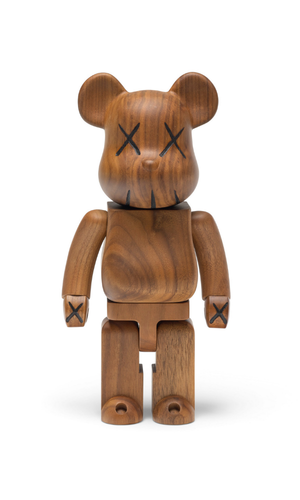
KAWS is the working name of Brian Donnelly (b. 1974, Jersey City). He began in the 1990s subverting bus-shelter and phone-booth advertisements, then built a singular visual language around the Companion — a Mickey-Mouse-descended figure with crossed-out X eyes — alongside Chum, BFF, Accomplice and a cast of appropriated cartoon characters. His practice spans paintings, screenprints, vinyl and bronze sculpture, and the monumental KAWS:Holiday installations shown in cities worldwide. His work is held by the Brooklyn Museum, the Modern Art Museum of Fort Worth, and major private collections, and he is among the most collected artists of his generation.