Gauntlet Gallery
What is KAWS’s piece called “Clean Slate (Grey)”?
Summary
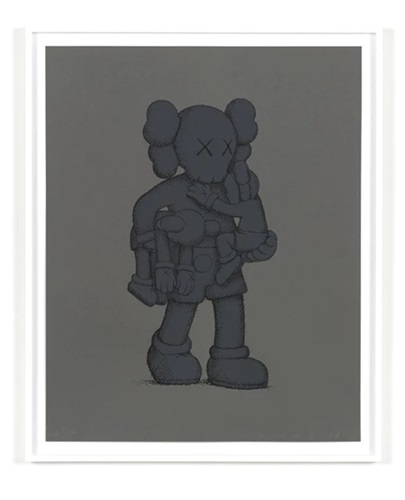
Clean Slate (Grey) depicts a large Companion figure cradling two smaller Companion children, a tender image of parenthood and protection rendered in a grey colorway. The composition shows the adult figure carrying its offspring, with the signature crossed X eyes and downcast cartoon features that give the work its characteristic warmth and melancholy. Originally realized by KAWS as a monumental sculpture, Clean Slate brings family and caregiving to the foreground of his iconography. The grey collectible version distills that emotional, multi-figure sculpture into domestic scale, preserving the work's intimate narrative of generational care.
Why It Matters
Clean Slate is among KAWS's most explicitly familial compositions, presenting the Companion as a parent carrying children and extending his recurring themes of companionship and care into the realm of family and lineage. Conceived as a monumental sculpture, it became a signature piece in KAWS's large-scale exhibition practice and one of the most emotionally direct works in his catalog. Collectible grey editions let collectors own a version of an otherwise public-scale sculpture, and the family motif gives the piece broad emotional resonance. It matters because it deepens the narrative ambition of KAWS's characters, moving from solitary icons and pairs toward a multi-generational family group. The work reflects the maturation of KAWS's themes, where his cartoon vocabulary is used to address tenderness, protection, and renewal, reinforcing why his characters connect so powerfully with a global audience across art, toy, and design communities.
Collector Perspective
Clean Slate (Grey) appeals to collectors who favor KAWS's emotional, family-themed compositions and multi-figure works over single characters. The grey colorway is restrained and gallery-friendly, making the piece a strong sculptural display centerpiece even at collectible scale. Within a KAWS collection it pairs naturally with Along The Way and Companion works, reinforcing the companionship-and-family narrative thread. Buyers should confirm the specific format and colorway and keep original packaging, as the composition exists at monumental and collectible scales with differing values and desirability.
Historical Context
Clean Slate sits in KAWS's monumental and mature fine-art period, when he expanded his Companion vocabulary into large sculptures and emotionally complex multi-figure groupings. It follows directly from the solitary Companion and paired compositions, advancing toward an explicitly familial subject of a parent carrying children. The work belongs to the same exhibition-defining body of monumental sculptures that established KAWS's international standing, marking the phase in which his graffiti-and-toy origins matured into ambitious, narrative-driven fine art rendered at architectural scale.
FAQ
What does Clean Slate depict?
A large Companion figure carrying two smaller Companion children, a tender image of parenthood and protection.
Was it originally a sculpture?
Yes, KAWS first realized Clean Slate as a monumental sculpture before it appeared in collectible and print formats.
What themes does it explore?
Family, caregiving, and generational renewal, extending KAWS's companionship themes into an explicitly familial subject.
What should buyers confirm?
The specific format and colorway plus original packaging; the composition exists at multiple scales with differing values.
Related Works
About the Artist
KAWS is the working name of Brian Donnelly (b. 1974, Jersey City). He began in the 1990s subverting bus-shelter and phone-booth advertisements, then built a singular visual language around the Companion — a Mickey-Mouse-descended figure with crossed-out X eyes — alongside Chum, BFF, Accomplice and a cast of appropriated cartoon characters. His practice spans paintings, screenprints, vinyl and bronze sculpture, and the monumental KAWS:Holiday installations shown in cities worldwide. His work is held by the Brooklyn Museum, the Modern Art Museum of Fort Worth, and major private collections, and he is among the most collected artists of his generation.