Gauntlet Gallery
What is KAWS’s piece called “Lost Time; Alone Again; Far Far Down”?
Summary
This grouping draws on KAWS's recurring meditation on time, isolation, and emotional weight, themes that surface across his painting and editioned work. Titles like "Lost Time," "Alone Again," and "Far Far Down" reflect the melancholic register KAWS folds into his otherwise bright, cartoon-derived visual language, where Companion-type figures slump, cover their faces, or sink into flattened fields of color. The works trade on his signature crossed-out eyes and rounded, appropriated forms, rendered with the crisp graphic finish that defines his fine-art output. Presented here as a high-value reference entry, it sits within the more serious, gallery-facing side of KAWS's practice rather than his accessible open editions.
Why It Matters
KAWS is one of the most commercially dominant artists to emerge from a street-art and toy-design background, and his more somber, large-scale and unique works represent the upper register of his market. The motifs evoked by these titles, time slipping away, loneliness, descent, are central to why critics take KAWS seriously beyond the merchandise: he uses the friendliest possible vocabulary, cartoon characters and candy colors, to deliver feelings of grief, exhaustion, and alienation. That tension between pop surface and emotional undertow is the engine of his fine-art reputation and his auction performance. Works in this serious vein anchor major private collections and museum-adjacent holdings, and they help justify the premiums paid across the rest of his catalog. For a collector, an entry like this signals the conceptual core of KAWS rather than the entry-level product, and it carries the cultural weight that has made his name a fixture of 21st-century contemporary art conversations and record-setting sales.
Collector Perspective
This tier appeals to established contemporary-art collectors rather than first-time KAWS buyers, the audience that pursues paintings, large sculptures, and unique works over open-edition prints. Display appeal lies in scale and presence: these are statement pieces meant to anchor a wall or room, and their melancholic theme reads as more art-historically ambitious than the cheerful Companion editions. Within a KAWS collection, a work like this functions as a cornerstone, the serious anchor that contextualizes the accompanying prints, vinyl figures, and plush. Buyers at this level care about provenance, condition, and the conceptual through-line of time and isolation that distinguishes KAWS's gallery output. It is a holding meant to demonstrate depth of commitment rather than breadth.
Historical Context
KAWS, born Brian Donnelly, moved from 1990s subway and billboard interventions into vinyl toys, then into painting and monumental sculpture that earned him blue-chip gallery and auction status. Emotionally weighted, time-themed works sit on the fine-art end of that arc, the phase where his appropriated cartoon vocabulary matured into a vehicle for melancholy and mortality rather than pure pop pleasure. This is the register that distanced him from being read merely as a toy designer and aligned him with serious contemporary painting. Positioned here as a premium reference entry, it reflects the mature, gallery-facing KAWS whose surfaces stay bright while his subject matter turns inward.
FAQ
What does this work depict?
It draws on KAWS's recurring themes of lost time, loneliness, and emotional descent, expressed through his crossed-out-eye, cartoon-derived figures and flattened color fields.
Why is it priced so much higher than KAWS prints?
Works in KAWS's serious, gallery-facing vein, paintings and unique or large-scale pieces, command far more than his accessible open-edition prints and figures.
Where does this sit in KAWS's career?
It belongs to the mature, fine-art phase where his appropriated pop vocabulary carries melancholy and introspection rather than pure cheerfulness.
Who typically collects work at this level?
Established contemporary-art collectors who pursue KAWS's paintings and major works as cornerstones rather than entry-level editions.
Related Works
About the Artist
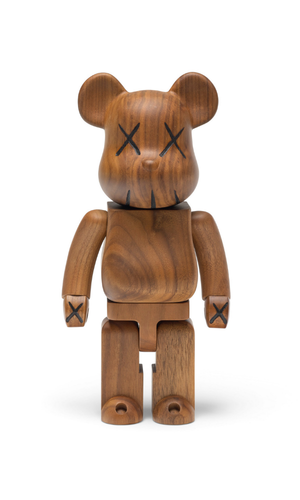
KAWS is the working name of Brian Donnelly (b. 1974, Jersey City). He began in the 1990s subverting bus-shelter and phone-booth advertisements, then built a singular visual language around the Companion — a Mickey-Mouse-descended figure with crossed-out X eyes — alongside Chum, BFF, Accomplice and a cast of appropriated cartoon characters. His practice spans paintings, screenprints, vinyl and bronze sculpture, and the monumental KAWS:Holiday installations shown in cities worldwide. His work is held by the Brooklyn Museum, the Modern Art Museum of Fort Worth, and major private collections, and he is among the most collected artists of his generation.