Gauntlet Gallery
What is KAWS’s piece called “Kaws Teapot (Black)”?
Summary
A black KAWS teapot, a functional ceramic/homeware object that carries KAWS's design language into the realm of everyday tableware. Like his other applied-design releases, it merges utility with the artist's branded identity, offering collectors a sculptural yet usable piece. The black colorway gives it a sleek, graphic presence. Released as a limited homeware object, the teapot extends KAWS's long practice of blurring the boundary between fine art, designed product, and lifestyle object. Specific edition size and materials are not confirmed here, so it is best understood generally as a limited KAWS-designed functional object.
Why It Matters
The teapot exemplifies KAWS's comfort operating across the full spectrum from monumental sculpture down to intimate household objects. By lending his identity to a teapot, KAWS continues a lineage of artists and brands turning collectible design into accessible art, while reinforcing his own ethos that designed consumer goods can be legitimate vehicles for his work. For collectors, homeware like this offers an affordable, tactile point of entry and a conversation piece that lives in daily domestic space rather than on a plinth. It also speaks to KAWS's broad commercial reach and the way his name confers desirability across categories, from plush toys to apparel to tableware. While it is a minor entry relative to his Companion sculptures or major prints, the teapot is part of what makes KAWS one of the most pervasive artist-brands of his generation, present in galleries, museums, sneaker drops, and kitchens alike. That ubiquity is itself central to his cultural significance.
Collector Perspective
This object draws collectors who appreciate KAWS's design-object side and want an accessible, usable piece. The black colorway is understated and pairs well with modern interiors, functioning equally as a display item on a shelf or an actual teapot. In a broader KAWS collection it adds breadth, showing the artist's range beyond figures and prints into lifestyle and homeware. Design collectors and gift-buyers also pursue it. Collectors should weigh condition carefully given that ceramics chip, and original packaging tends to enhance resale appeal. It is unlikely to anchor a collection but rounds one out nicely.
Historical Context
The teapot sits in KAWS's contemporary applied-design output, where his identity is deployed across consumer and lifestyle categories. It reflects a late stage of his arc, after graffiti, vinyl toys, fine-art painting, and monumental sculpture had already established his name, when his brand power allowed expansion into homeware and everyday objects. Such pieces are continuous with his earlier toy and merchandise releases in spirit, treating mass-producible design as a valid extension of his art practice rather than a dilution of it. It underscores how thoroughly KAWS has integrated commerce and art.
FAQ
Can the KAWS teapot actually be used?
It is designed as a functional teapot, but most collectors keep it as a display object to preserve its condition and value. Exact material and capacity details are not confirmed here.
Is this a rare KAWS piece?
It is a limited homeware object rather than a marquee work like a Companion sculpture. We describe it generally as limited because precise edition figures are not verified.
Why would a KAWS collector want a teapot?
It showcases KAWS's design-object range and offers an accessible, tactile piece that lives in everyday space, adding breadth to a collection dominated by figures and prints.
About the Artist
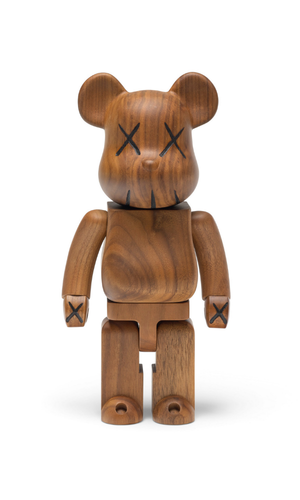
KAWS is the working name of Brian Donnelly (b. 1974, Jersey City). He began in the 1990s subverting bus-shelter and phone-booth advertisements, then built a singular visual language around the Companion — a Mickey-Mouse-descended figure with crossed-out X eyes — alongside Chum, BFF, Accomplice and a cast of appropriated cartoon characters. His practice spans paintings, screenprints, vinyl and bronze sculpture, and the monumental KAWS:Holiday installations shown in cities worldwide. His work is held by the Brooklyn Museum, the Modern Art Museum of Fort Worth, and major private collections, and he is among the most collected artists of his generation.