Gauntlet Gallery
What is KAWS’s piece called “Better Knowing”?
Summary
A KAWS print whose composition draws on his signature visual language of cropped, layered cartoon forms, bold flat color fields, and the crossed-out X eyes embedded within abstracted appropriated imagery. Works with titles like "Better Knowing" typically present a tightly composed graphic in KAWS's mature print idiom, where recognizable fragments of pop and cartoon iconography are reorganized into a near-abstract, emotionally charged surface. As a fine-art print it carries the crisp, saturated quality of his screenprint output, intended for wall display and reflecting the same iconography he develops in his paintings.
Why It Matters
Prints are central to how KAWS reaches collectors, allowing his painting-scale imagery to circulate widely as limited editions at a more accessible price than unique canvases. "Better Knowing" exemplifies the way Donnelly mines cartoon and advertising sources, then fractures and recombines them so the original reference is half-hidden behind flat shapes, contour lines, and his recurring X-eye motif. This appropriation strategy traces directly back to his graffiti-era practice of altering existing advertisements, now elevated into refined editions. Such prints matter because they let a wide audience own a fully resolved piece of KAWS imagery while supporting the secondary market that surrounds his work. They also document his ongoing dialogue with consumer culture and mass imagery, a theme that has defined his career. For many collectors, a strong KAWS print is the most attainable way to engage seriously with his visual world.
Collector Perspective
This print appeals to collectors who want gallery-quality KAWS imagery on the wall without the cost of a unique painting. Its graphic punch and saturated color make it a confident focal point in modern interiors, and it pairs well with other KAWS prints in a grouping. Within a collection it functions as core wall content, complementing sculptures and figures. Collectors prize KAWS prints with crisp registration, full margins, and clear edition documentation, and well-kept examples with signatures and numbering are the most sought after. As an editioned work it offers liquidity and a recognizable place in the artist's print catalog.
Historical Context
"Better Knowing" sits within KAWS's fine-art and editioned print practice, a phase built on the foundation of his earlier street and toy work. His method of appropriating and recombining cartoon and advertising imagery began with 1990s graffiti interventions on public ads, evolved through his SpongeBob, Smurfs, and other cartoon-derived experiments, and matured into highly resolved paintings and prints. This work reflects that later, studio-based stage, where the source imagery is abstracted into KAWS's own compositional system. It shows how thoroughly he transformed appropriation from a subversive street gesture into a signature fine-art language.
FAQ
Is this an original painting or a print?
It is a fine-art print in KAWS's editioned practice, derived from his painting-style imagery.
What is KAWS's print imagery based on?
He frequently appropriates and abstracts cartoon and advertising sources, layering them with flat color and his X-eye motif.
What should I look for in condition?
Crisp color, full margins, no fading or handling marks, and intact signature and numbering where applicable.
Are KAWS prints limited editions?
His prints are typically released as limited, numbered editions; specific size should be confirmed against documentation.
About the Artist
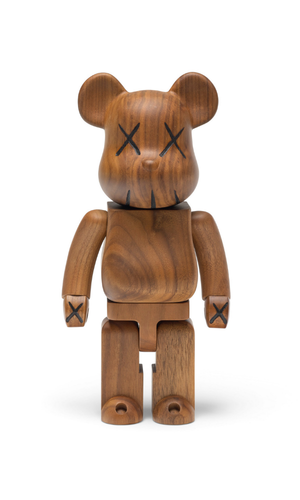
KAWS is the working name of Brian Donnelly (b. 1974, Jersey City). He began in the 1990s subverting bus-shelter and phone-booth advertisements, then built a singular visual language around the Companion — a Mickey-Mouse-descended figure with crossed-out X eyes — alongside Chum, BFF, Accomplice and a cast of appropriated cartoon characters. His practice spans paintings, screenprints, vinyl and bronze sculpture, and the monumental KAWS:Holiday installations shown in cities worldwide. His work is held by the Brooklyn Museum, the Modern Art Museum of Fort Worth, and major private collections, and he is among the most collected artists of his generation.