Gauntlet Gallery
What is KAWS’s piece called “Ups And Downs (Print Set)”?
Summary
Ups And Downs is a screenprint portfolio by KAWS (Brian Donnelly) presenting a suite of related images conceived as a cohesive set rather than a single sheet. Working in his signature flat-graphic vocabulary, KAWS deploys cropped cartoon body parts, layered hands, and the crossed-out X eyes that define his appropriated characters. The print set reads like a sequence of emotional registers, the title gesturing toward the swings of mood and fortune that recur as quiet undercurrents in his pop imagery. Executed as limited screenprints with the saturated, hard-edged color and precise registration KAWS demands, the portfolio rewards being shown together, each sheet amplifying the others as a single statement.
Why It Matters
Print portfolios occupy an important place in KAWS's practice because they let him work serially, exploring a motif across multiple plates the way a painter develops a body of canvases. A multi-sheet set like Ups And Downs is more committing for collectors than a single print and therefore tends to be produced in smaller quantities and held more tightly, which compounds its desirability. The work demonstrates how KAWS translates the language of comics and advertising into editioned fine art, collapsing the distance between mass culture and the print room. For collectors, an intact set is the prize: complete portfolios with matching numbering and original packaging are the configuration the market most rewards, and breaking a set is generally seen as diminishing it. The portfolio format also signals KAWS's seriousness as a printmaker, situating him within a lineage of pop artists who used the multiple as a primary medium rather than a marketing byproduct, and underscoring why his editioned output is collected with the rigor usually reserved for unique works.
Collector Perspective
Ups And Downs appeals to established KAWS collectors who want depth rather than a single trophy image, and to print specialists who value complete, in-sequence portfolios. Displayed as a grid or run, the set makes a strong wall statement and signals a committed collection rather than a casual purchase. Within a KAWS holding it functions as an anchor, complementing single Companion and Chum sheets while standing apart through its serial ambition. Condition and completeness drive value here more than for stand-alone prints: collectors prize matching edition numbers, untrimmed margins, and original portfolio housing. Because sets are harder to assemble and easier to break up, an intact example is the configuration most sought after.
Historical Context
The work sits in KAWS's mature print practice, after his subway and graffiti beginnings and the toy era that built his audience, when editioned screenprints became a central, ongoing strand of his studio output. By this stage KAWS had fully developed the flat-graphic, appropriation-driven idiom that lets him build entire portfolios from cropped cartoon anatomy and crossed-out eyes. A print set rather than a single sheet reflects his interest in serial image-making, a thread that runs parallel to his paintings and sculptures and connects him to the pop-art tradition of the fine-art multiple as a primary medium.
FAQ
Is Ups And Downs a single print or a set?
It is conceived and sold as a print set, a portfolio of related screenprints meant to be kept and shown together rather than a single sheet.
Does it matter if the set is complete?
Yes. For KAWS print portfolios, completeness, matching edition numbers, and original packaging materially affect desirability; an intact set is the configuration the market most rewards.
What technique is used?
It is produced as limited screenprints, the medium KAWS favors for his editions, prized for saturated flat color and precise registration. Specific edition size and dimensions should be confirmed against published documentation.
About the Artist
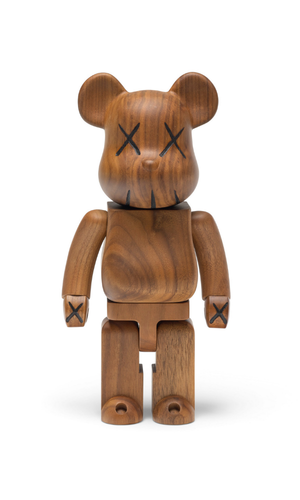
KAWS is the working name of Brian Donnelly (b. 1974, Jersey City). He began in the 1990s subverting bus-shelter and phone-booth advertisements, then built a singular visual language around the Companion — a Mickey-Mouse-descended figure with crossed-out X eyes — alongside Chum, BFF, Accomplice and a cast of appropriated cartoon characters. His practice spans paintings, screenprints, vinyl and bronze sculpture, and the monumental KAWS:Holiday installations shown in cities worldwide. His work is held by the Brooklyn Museum, the Modern Art Museum of Fort Worth, and major private collections, and he is among the most collected artists of his generation.