Gauntlet Gallery
What is KAWS’s piece called “Astro Boy (Kaws Version) (Grey)”?
Summary
Astro Boy (KAWS Version) (Grey) is KAWS's reworking of Osamu Tezuka's iconic manga and anime robot, rendered here in a muted grey colorway. KAWS appropriates the beloved character and overlays his signature treatment, most notably the crossed-out X eyes and his flattened, hard-edged graphic sensibility, transforming a cherished symbol of Japanese pop culture into a KAWS object. Issued as a collectible figure or print in his Astro Boy series, the grey version offers a restrained, monochromatic take that emphasizes silhouette and form over bright color. The piece sits at the intersection of KAWS's cartoon-appropriation practice and his deep ties to Japanese collecting culture, where Astro Boy carries enormous nostalgic weight.
Why It Matters
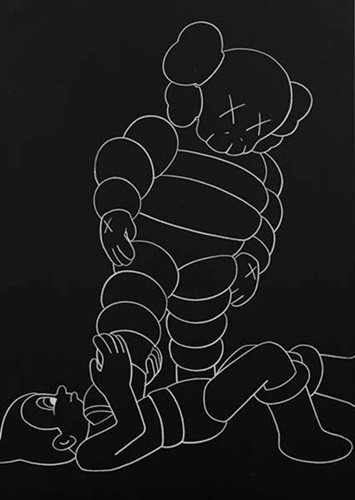
KAWS's Astro Boy is a clear instance of his core strategy: taking a universally loved character and subjecting it to his X-eyed, appropriation-driven transformation, claiming mass-cultural icons as raw material for his own vocabulary. Astro Boy is especially resonant because it bridges KAWS's American street-art roots and his profound relationship with Japan, where his career was significantly shaped by collaborations with Japanese brands and where Astro Boy is a foundational pop figure. By rendering the character in his own idiom, KAWS performs the same gesture he applies to Mickey Mouse, the Simpsons, and SpongeBob, reframing collective nostalgia through his crossed-out lens. The grey colorway matters to collectors who track variants, since different colorways of the same KAWS design carry distinct desirability and scarcity. As part of a recognized series with a Chum-versus-Astro-Boy counterpart, the work also participates in KAWS's habit of staging his own characters against appropriated ones, a dynamic that gives his output internal narrative and collectible depth.
Collector Perspective
This piece draws collectors of KAWS's cartoon-appropriation works and those with a particular interest in his Japanese connections and the Astro Boy theme. The grey colorway suits collectors who favor restrained, monochromatic objects that integrate easily into a range of interiors, and variant-focused buyers who want to assemble the colorway range. Within a KAWS collection it complements the related Chum vs Astro Boy edition and reinforces the appropriation thread alongside Companion and Chum pieces. As a more accessibly priced object, it can serve as an entry point or a completist addition; condition, originality, and any accompanying packaging or documentation drive its standing.
Historical Context
Astro Boy (KAWS Version) reflects KAWS's enduring engagement with appropriated cartoon icons and his deep ties to Japanese pop culture and collecting, relationships that helped propel his rise from graffiti and the vinyl-toy era into global recognition. Reworking Tezuka's robot places the piece firmly within the cartoon-appropriation lineage that runs from his early SpongeBob and Simpsons interventions through his Companion mythology. The existence of a related Chum vs Astro Boy work shows how KAWS stages appropriated characters against his own inventions, extending the narrative logic that links his series across this period of his practice.
FAQ
What is Astro Boy (KAWS Version)?
It is KAWS's appropriation of Osamu Tezuka's Astro Boy, reworked with his signature crossed-out eyes and flat graphic style, here issued in a grey colorway.
Why does KAWS use Astro Boy?
Astro Boy is a foundational figure in Japanese pop culture, and KAWS has deep ties to Japan; reworking the character continues his practice of claiming beloved mass-cultural icons as his own material.
Does the grey colorway matter?
Yes. KAWS releases the same designs in multiple colorways, and each can carry distinct desirability and scarcity. Specific edition size and release details should be confirmed against published records.
Related Works
About the Artist
KAWS is the working name of Brian Donnelly (b. 1974, Jersey City). He began in the 1990s subverting bus-shelter and phone-booth advertisements, then built a singular visual language around the Companion — a Mickey-Mouse-descended figure with crossed-out X eyes — alongside Chum, BFF, Accomplice and a cast of appropriated cartoon characters. His practice spans paintings, screenprints, vinyl and bronze sculpture, and the monumental KAWS:Holiday installations shown in cities worldwide. His work is held by the Brooklyn Museum, the Modern Art Museum of Fort Worth, and major private collections, and he is among the most collected artists of his generation.